

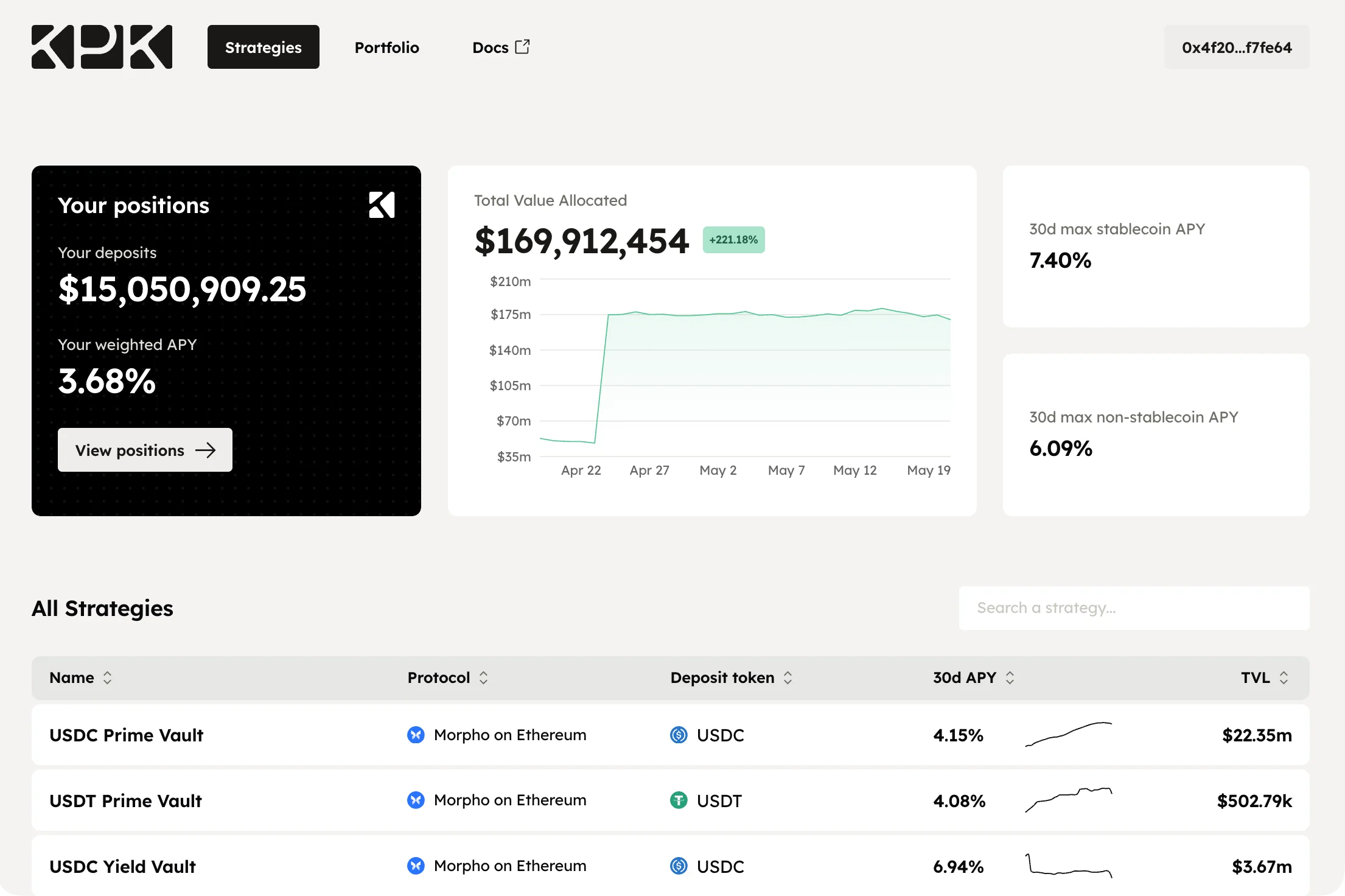
As KPK expanded its vault products, vaults.fyi expanded coverage around the protocols and products that mattered most to them. That includes the vaults KPK wanted to monitor internally, the products they wanted to expose to depositors, and the APIs, SDKs, and tools they needed to make those products accessible to integrators. The same coverage supports discovery, reporting, and integration. KPK can track their own products in the same normalized system that third-party platforms can use to discover and route into those vaults. 2. Data and Monitoring for DAO Treasury Workflows KPK uses vaults.fyi to support DAO treasury workflows that depend on accurate, normalised data. The treasury team pulls address holdings, position data, and historical metrics through the API to monitor exposures and run internal calculations. When execution is needed, KPK signs from its own wallet and executes against the underlying protocol, fully non-custodial throughout. That matters for teams operating DAO treasuries across multiple vault protocols. They need reliable data, consistent vault metadata, and a workflow that does not require rebuilding every protocol integration from scratch. 3. Portfolio And Position Tracking KPK also uses vaults.fyi position data to support portfolio visibility. The API can return balances, accrued yield, and historical performance across supported vault positions. For KPK, that data can supplement customer reporting and internal monitoring. For integrators, the same infrastructure makes vault positions easier to show inside wallets, dashboards, and custom applications. 4. Infrastructure For KPK’s Own App KPK’s vault portal at app.kpk.io uses vaults.fyi APIs as its underlying yield infrastructure. Vault metadata, market data, transaction payloads, and position tracking all come from the same API surface. That lets KPK own the user experience and curation layer while vaults.fyi handles the integration layer underneath. KPK focuses on strategy design, curation, and the depositor experience. Vaults.fyi provides one of the integration layers that helps make those vaults accessible across surfaces. Why It Matters KPK shows one expansion path for serious vault teams. Data is the entry point. Once a team works with the data layer, the same infrastructure can support monitoring, attribution, and custom distribution. That expansion compounds because each layer uses the same underlying integrations, which reduces duplication across data, monitoring, and distribution workflows. “vaults.fyi has been a useful data partner from the start. Their coverage across protocols meant we could move quickly on app.kpk.io and on internal monitoring without rebuilding every integration ourselves.” — João Bandeira, Product Engineering Lead, KPK What’s Next KPK and vaults.fyi continue to expand the relationship as KPK launches new vault structures and distribution paths. The next stage is deeper integrator support, better fee accounting feedback loops, and clearer reporting around the TVL that each channel drives. The relationship started with a single data feed. It now points toward a broader infrastructure partnership for curated vault products.